Sustainable Retrofit: Thermal Upgrades and the Route to Net Carbon Reduction
For many property owners, sustainability is no longer confined to new-build design. Increasingly, attention is turning to existing buildings and how they can be upgraded to perform better, cost less to run, and respond to the UK’s wider carbon reduction targets. In practice, sustainable retrofit has become an important conversation in both residential and commercial architecture, particularly as older buildings often present the greatest opportunity for long-term environmental improvement.
Improving Existing Building Performance
Thermal upgrades are an effective starting point. In many existing properties, particularly those built before modern regulations, heat loss through roofs, walls, glazing and floors is significant. Measures such as improved insulation, upgraded glazing and airtightness improvements can dramatically improve comfort while reducing energy demand. These interventions are often most successful when considered together rather than in isolation, allowing the building to perform as a complete thermal envelope rather than relying on one individual upgrade.
The same principle applies to heating systems. Across both domestic and commercial projects, low-carbon technologies such as heat pumps are becoming increasingly common, but it’s important to note that they work best when paired with a building with strong thermal performance. To encourage the installation of these low-carbon technologies, the government’s Ofgem Boiler Upgrade Scheme currently offers grants of £7,500 towards eligible air source and ground source heat pump installations in England and Wales, helping offset the upfront cost for homeowners and certain non-domestic properties.
You can find the link to the scheme here: https://www.ofgem.gov.uk/guidance/boiler-upgrade-scheme-guidance-property-owners
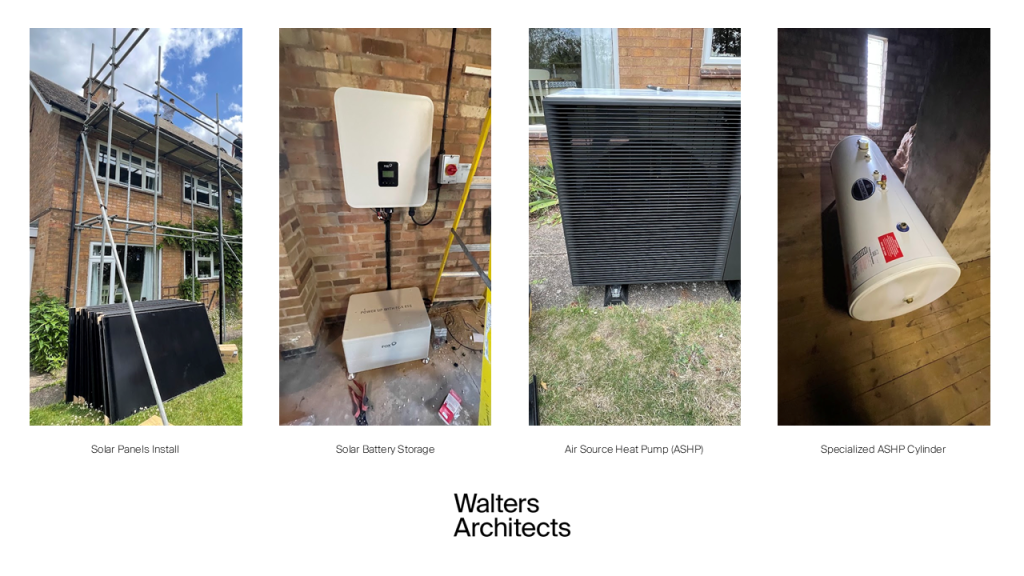
This is a grant scheme we have drawn upon in practice on one of our recent sustainable retrofit projects. An air source heat pump (ASHP) was introduced to the existing property as part of a wider energy upgrade strategy. Alongside the ASHP, solar panels were incorporated as an additional renewable technology, with cavity wall insulation also installed to strengthen the building’s thermal performance. Together, these measures were considered as part of a coordinated approach, improving both the efficiency of the property and the effectiveness of the new low-carbon systems.
Policy, Grants and National Direction
The wider legislative direction is clear: buildings must become more energy efficient if the UK is to meet its net zero commitments. Existing homes remain central to this challenge because much of the housing stock that will exist in 2050 has already been built. Schemes such as the government’s Help to Heat programme and local authority-led retrofit funding continue to support insulation, heating improvements and low-carbon technologies, particularly for lower-performing homes.
You can have a look at available government schemes here: https://www.gov.uk/government/collections/find-energy-grants-for-you-home-help-to-heat
For landlords and businesses, energy performance is also becoming increasingly tied to regulation. Minimum efficiency standards continue to influence investment decisions, particularly where rental properties or older commercial stock are involved.
Long-Term Value Beyond Compliance
Retrofit is frequently viewed only through the lens of regulatory compliance or national carbon reduction targets, yet its wider value is often underestimated. When implemented thoughtfully, interventions to an existing building can significantly improve performance while generating long-term financial benefit. Enhanced thermal efficiency, reduced draughts, improved internal temperature stability, and more predictable energy demand all contribute to a building that performs more effectively through the seasons. For homeowners, these improvements are often immediately noticeable through lower heating requirements, improved comfort during colder periods, and increased confidence that the home is operating efficiently rather than continuously wasting energy.
For commercial property owners and businesses, the long-term value can be equally significant. Lower operational energy costs become increasingly important as utility prices remain unpredictable, while improved building performance can strengthen the long-term attractiveness of an asset for occupation, leasing or future resale. A well-considered retrofit can also reduce future maintenance pressures by integrating more durable systems and modern building components at the right stage of a project. In many cases, these upgrades are not simply technical improvements; they are strategic decisions that help existing buildings remain viable, efficient and relevant for many years ahead.